
Types of Trucks in India: Load Capacity Chart & Calculation Guide (2026)
Discover the different types of trucks in India, their load capacities, payload limits, and GVW calculations in this complete 2026 guide. Compare 6, 10, 12, 14, 16, and 18 tyre trucks with an easy-to-understand load capacity chart to choose the right vehicle for your transport needs
Summary: Trucks are the backbone of India’s logistics industry, and choosing the right vehicle depends on its load capacity, payload, and GVW limits. The right truck helps reduce transportation costs, improve efficiency, and ensure compliance with legal weight regulations.
In this blog, you’ll learn about truck types, load capacity, why different capacity trucks are needed, truck configurations and wheel count, load capacity charts, truck type-wise load capacities, and how to calculate truck load capacity for smarter logistics planning.
What is Truck Load Capacity?
Truck load capacity is the maximum weight of cargo a truck can safely carry, excluding its own weight. Also called payload capacity, it is measured in kilograms or tons and depends on the truck’s GVW, axle configuration, and design, ensuring safe, efficient, and legally compliant transportation.
Types of Trucks in India
India’s logistics industry uses a wide range of trucks to transport goods across different distances and industries. Based on their size and wheel configuration, common truck types include 6-tyre trucks, 10-tyre trucks, 12-tyre trucks, 14-tyre trucks, 16-tyre trucks, 18-tyre trucks, and 22-tyre trucks. Smaller trucks are ideal for city deliveries and light cargo, while multi-axle trucks are designed for carrying heavy loads over long distances. Choosing the right truck type based on its load capacity.
Why Different Capacity Trucks Are Needed
Different truck load capacities are essential for meeting the diverse transportation needs of businesses across India. Small trucks are ideal for local deliveries, while high-capacity vehicles transport bulk goods over long distances. Choosing the right truck load capacity helps improve efficiency, reduce logistics costs, maximize payload, and ensure compliance with legal weight regulations.
Understanding Common Truck Configurations and Wheel Count in India
Configuration | Wheels/Tyres | Axles | Common Name |
|---|---|---|---|
LCV / Small Truck | 4–6 | 2 | Mini Truck, Pickup |
Medium Truck | 6 | 2 | 6 Wheeler, 6 Chakka |
Heavy Truck | 10 | 3 | 10 Wheeler, 10 Chakka |
Multi-Axle | 12 | 4 | 12 Wheeler, 12 Chakka |
Heavy Multi-Axle | 14 | 5 | 14 Wheeler, 14 Chakka |
Trailer / MAV | 18–22 | 6+ | 18 Wheeler, Trailer Truck |
In India, trucks are also referred to by the number of “chakka” (wheels): 6 chakka, 10 chakka, 12 chakka, and 14 chakka trucks — all common names in the transport industry.
Complete Truck Load Capacity Chart: Truck Type, Tyres, Axles, Payload & GVW
Truck Type | Tyres/Wheels | Axles | Load Capacity (Tons) | GVW (Approx.) | Typical Use |
Pickup / Mini Truck | 4–6 | 2 | 1–3 tons | 3.5–7 tons | Last-mile, e-commerce |
6 Tyre Truck (6 Wheeler) | 6 | 2 | 7–10 tons | 16–18 tons | Urban freight, SME cargo |
10 Tyre Truck (10 Wheeler) | 10 | 3 | 15–25 tons | 25–31 tons | Heavy industry, bulk goods |
12 Tyre Truck | 12 | 4 | 25–30 tons | 37–40 tons | Steel, containers, ODC |
14 Tyre Truck | 14 | 5 | 30–35 tons | 43–49 tons | Long-haul, heavy cargo |
16 Tyre Truck | 16 | 5–6 | 35–40 tons | 49–55 tons | Heavy industrial goods |
18 Tyre Truck | 18 | 6 | 40–49 tons | 55–60 tons | Bulk commodities, trailers |
20–22 Tyre Trailer | 20–22 | 7+ | 50+ tons | 65+ tons | ODC, heavy machinery |
Note: Actual truck load capacity in tons varies by manufacturer, model, and state regulations. Always verify with your Regional Transport Office (RTO).
Truck Type-wise Load Capacity Details in India
Understanding truck load capacity by type helps select the right vehicle for every shipment. Different truck configurations offer varying payload capacities, making them suitable for city deliveries, industrial transport, and long-distance freight across India.
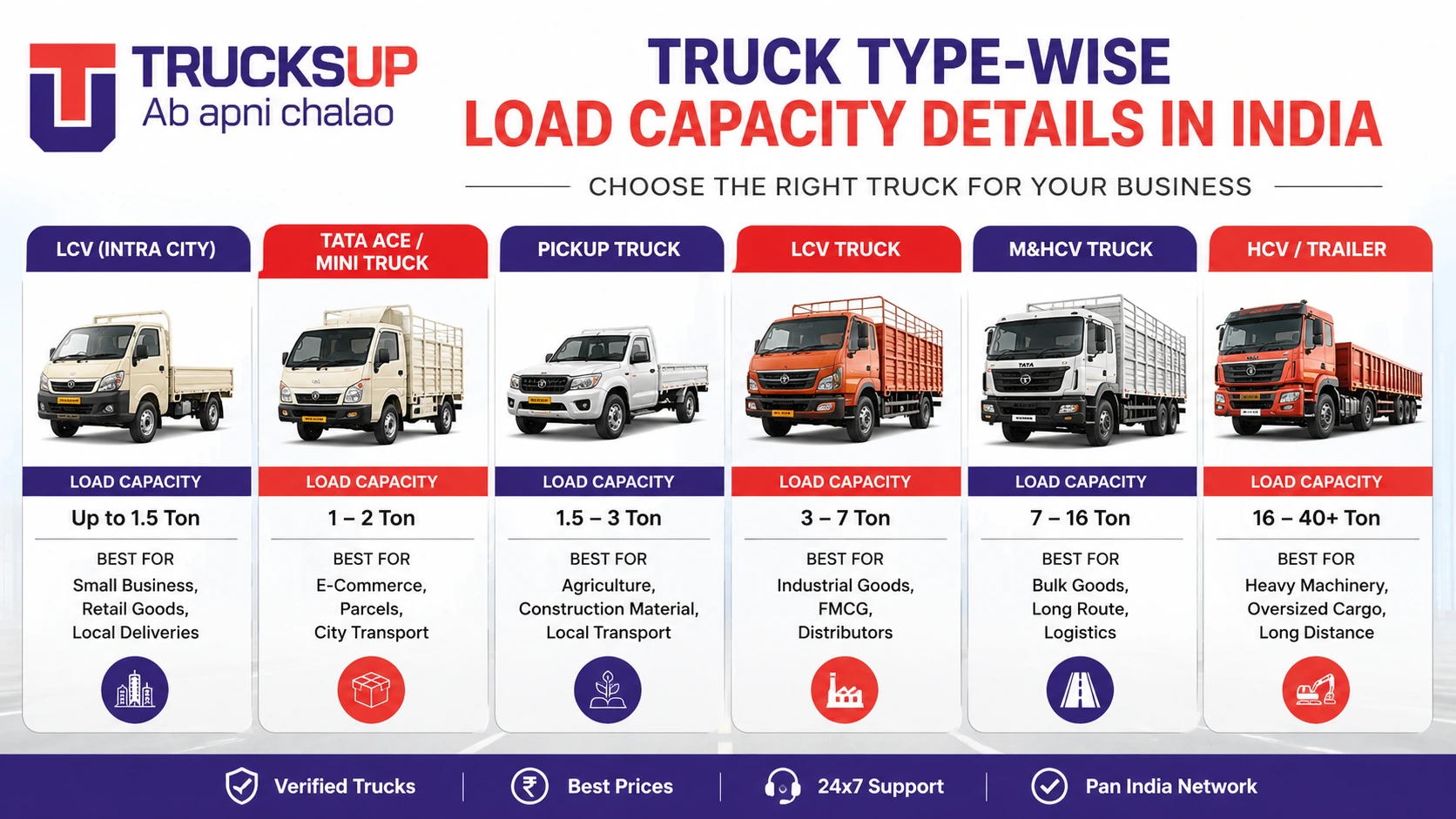
6 Tyre Truck Load Capacity (6 Wheeler / 6 Chakka)
The 6 tyre truck load capacity is 7 to 10 tons. With a maximum permissible GVW of 16,200 kg in India, and an unladen weight of around 6,500–9,000 kg, the net payload comes to approximately 7–9.5 tons. The 6 wheel truck is ideal for construction materials (sand, cement, bricks), agricultural produce, and urban freight. Popular models include the Tata LPT 1613 and Ashok Leyland Partner.
10 Tyre Truck Load Capacity (10 Wheeler / 10 Chakka)
The 10 tyre truck load capacity is 15 to 25 tons. This 3-axle truck has a maximum GVW of 25,000–31,000 kg. The 10 wheeler truck load capacity in India makes it the most used truck for heavy inter-city transport — bulk materials, industrial goods, and steel. The 10 tyre tipper load capacity (hyva trucks) is 15–20 tons, widely used in mining and construction. Standard 10 wheeler truck capacity in cubic metre is approximately 30–40 m³ for open body variants.
12 Tyre Truck Load Capacity (12 Wheeler / 12 Chakka)
The 12 tyre truck load capacity is 25 to 30 tons. India’s maximum permissible GVW for a 4-axle truck is 37 tons; subtracting the unladen weight of ~12 tons gives a net payload of 25–28 tons. The 12 tyre truck length in feet is typically 32–40 feet. The 12 wheeler truck sand capacity is approximately 18–24 tons per load. Popular models include Tata LPT 3723 and BharatBenz 3523R.
14 Tyre Truck Load Capacity (14 Wheeler / 14 Chakka)
The 14 tyre truck load capacity is 30 to 35 tons, with a GVW of 43–49 tons across 5 axles. The 14 tyre truck length in feet is 40–45 feet. These trucks are used for long-haul freight, steel plates, and heavy machinery. The 14 tyre truck passing weight is governed by CMVR regulations — overloaded vehicles face fines of ₹20,000+ at weigh bridges.
16 Tyre Truck Load Capacity (16 Wheeler)
The 16 tyre truck load capacity is 35 to 40 tons (GVW: 49–55 tons). The 16 wheeler truck load capacity in India is suited for heavy industrial goods, bulk cement, and steel. These vehicles must comply with axle load limits at every weigh bridge checkpoint.
18 Tyre Truck Load Capacity (18 Wheeler)
The 18 tyre truck load capacity is 40 to 49 tons — the highest in standard commercial trucking. The 18 wheeler truck capacity in tons makes it the primary choice for container haulage, petroleum tankers, and long-distance bulk freight. The 18 tyre tipper load capacity for mining applications is 30–40 tons.
Pickup Truck Load Capacity
The pickup load capacity ranges from 750 kg to 3 tons depending on the model. Small pickups like the Tata Ace carry ~750 kg–1 ton; medium LCVs carry up to 3 tons. The pickup load capacity in kg makes them ideal for last-mile delivery, e-commerce, and small business freight.
How to calculate the load capacity of a truck?
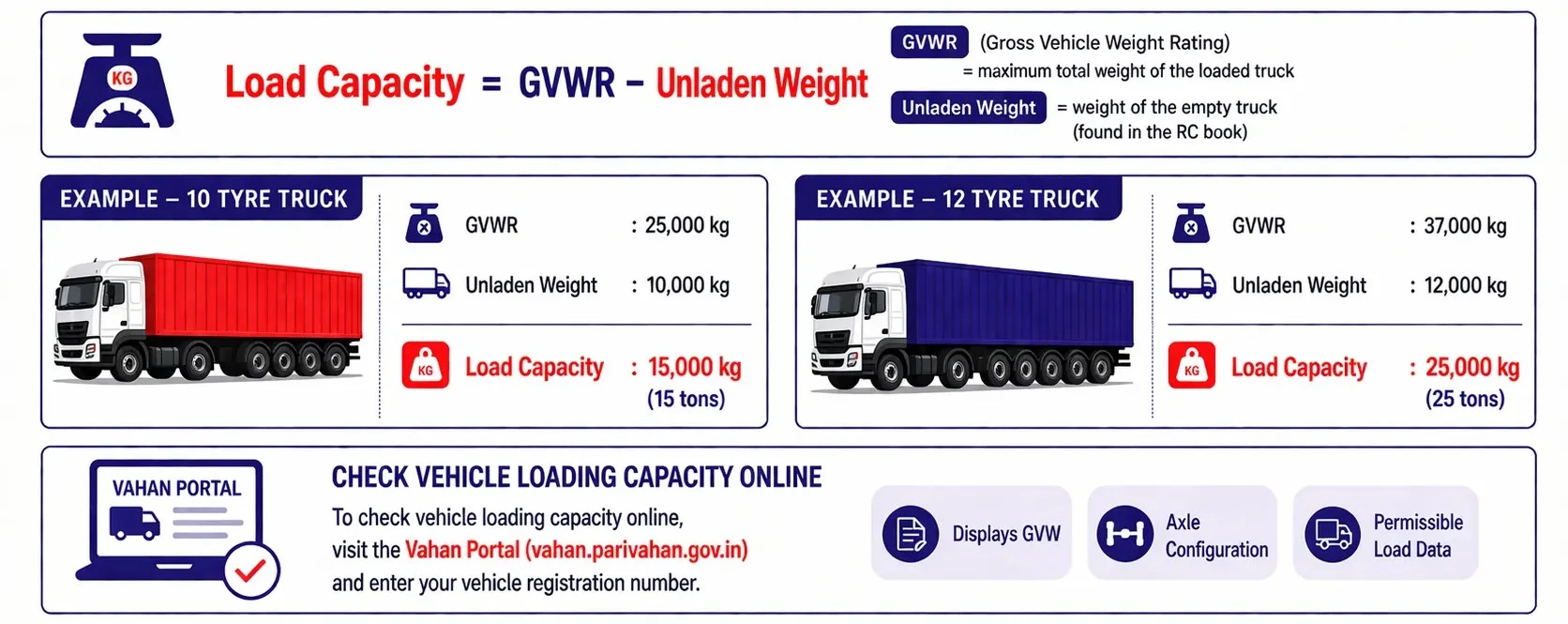
Formula: Load Capacity = GVWR − Unladen Weight
- GVWR (Gross Vehicle Weight Rating) = maximum total weight of the loaded truck
- Unladen Weight = weight of the empty truck (found in the RC book)
Example — 10 Tyre Truck:
- GVWR: 25,000 kg | Unladen Weight: 10,000 kg
- Load Capacity = 25,000 − 10,000 = 15,000 kg (15 tons)
Example — 12 Tyre Truck:
- GVWR: 37,000 kg | Unladen Weight: 12,000 kg
- Load Capacity = 37,000 − 12,000 = 25,000 kg (25 tons)
To check vehicle loading capacity online, visit the Vahan Portal (vahan.parivahan.gov.in) and enter your vehicle registration number. It displays GVW, axle configuration, and permissible load data.
Factors Affecting Truck Payload Capacity
A truck’s payload capacity depends on several factors, including Gross Vehicle Weight (GVW), axle configuration, tyre count, chassis strength, suspension system, and body type. Road conditions, cargo distribution, and legal weight regulations also influence the truck load capacity, making proper loading essential for safe and efficient transportation.
Truck Load Capacity in India — Key Regulations
The maximum load capacity of a truck in India is regulated under the Central Motor Vehicles Act (CMVA), 1988. Following the 2018 amendment, permissible axle loads were increased by ~20–25%. Overloading penalties start at ₹20,000 + ₹2,000 per extra ton. Trucks carrying over-dimensional cargo (ODC) require a Special Movement Permit from the State Transport Authority.
Conclusion
Understanding truck load capacity, payload, and GVW helps businesses choose the right vehicle for safe, cost-effective, and efficient transportation. Whether you need a 6 tyre truck for local deliveries or an 18 tyre truck for heavy freight, selecting the correct truck improves logistics performance and reduces operating costs. For quick and reliable online truck booking, download the TrucksUp App to compare truck types, check load capacities, and book the best truck for your transportation needs anywhere in India.
Truck Load Capacity in India: FAQs
Q.1) How many tons can a truck carry?
Truck load capacity depends on configuration. Typically, a 6-tyre truck carries 7–10 tons, 10-tyre handles 15–25 tons, 12-tyre carries 25–30 tons, and 18-tyre trucks can transport around 40–49 tons efficiently.
Q.2) What is the maximum load capacity of a truck in India?
In India, the maximum load capacity for standard trucks is about 49 tons, usually for 18-tyre multi-axle vehicles. Transporting heavier loads requires special Over Dimensional Cargo (ODC) permits and regulatory approvals from authorities.
Q.3) How Much Weight Can a Truck Carry?
A truck’s carrying capacity depends on its payload capacity and GVW. In India, trucks can typically carry 1 to 40+ tons, depending on their type, axle configuration, and legal weight limits.
Q.4) What is the load capacity of a 10 tyre truck?
A 10 tyre truck load capacity in India typically ranges from 16 to 18 tons, depending on the model, axle configuration, and Gross Vehicle Weight (GVW).
Q.5) What is the passing weight of a 12 wheeler truck in India?
The 12 wheeler truck passing weight in India generally ranges between 25 and 31 tons GVW, depending on RTO regulations and manufacturer specifications.
Q.6) How many wheels does a truck have?
A truck can have 4 to 22 wheels, depending on its configuration. Common options include 6 tyre, 10 tyre, 12 tyre, 14 tyre, 16 tyre, and 18 tyre trucks.
Q.7) What is a 3 ton vehicle?
A 3 ton vehicle is a light commercial truck with a 3-ton load capacity, commonly used for city logistics, retail deliveries, and small business transportation.
Q.8) What is the length of a 22 wheeler truck?
A 22 wheeler truck in India typically measures 40 to 45 feet in length, making it suitable for transporting heavy industrial and bulk cargo.
Q.9)What is the size of a 32 foot truck in India in meters?
A 32 foot truck measures approximately 9.75 meters in length, making it suitable for long-distance freight and medium-to-heavy cargo transportation.
Q.10) What is the size of a truck in India?
Truck size in India varies by type, ranging from 14 to 45 feet in length, depending on the truck load capacity, body type, and application.