
Electric Trucks in India (2026): Adoption Trends, Cost Savings & Government Policies
Explore how electric trucks are reshaping India’s logistics sector through lower operating costs, government EV incentives, expanding charging infrastructure, and practical fleet electrification strategies for transporters and fleet owners in 2026.
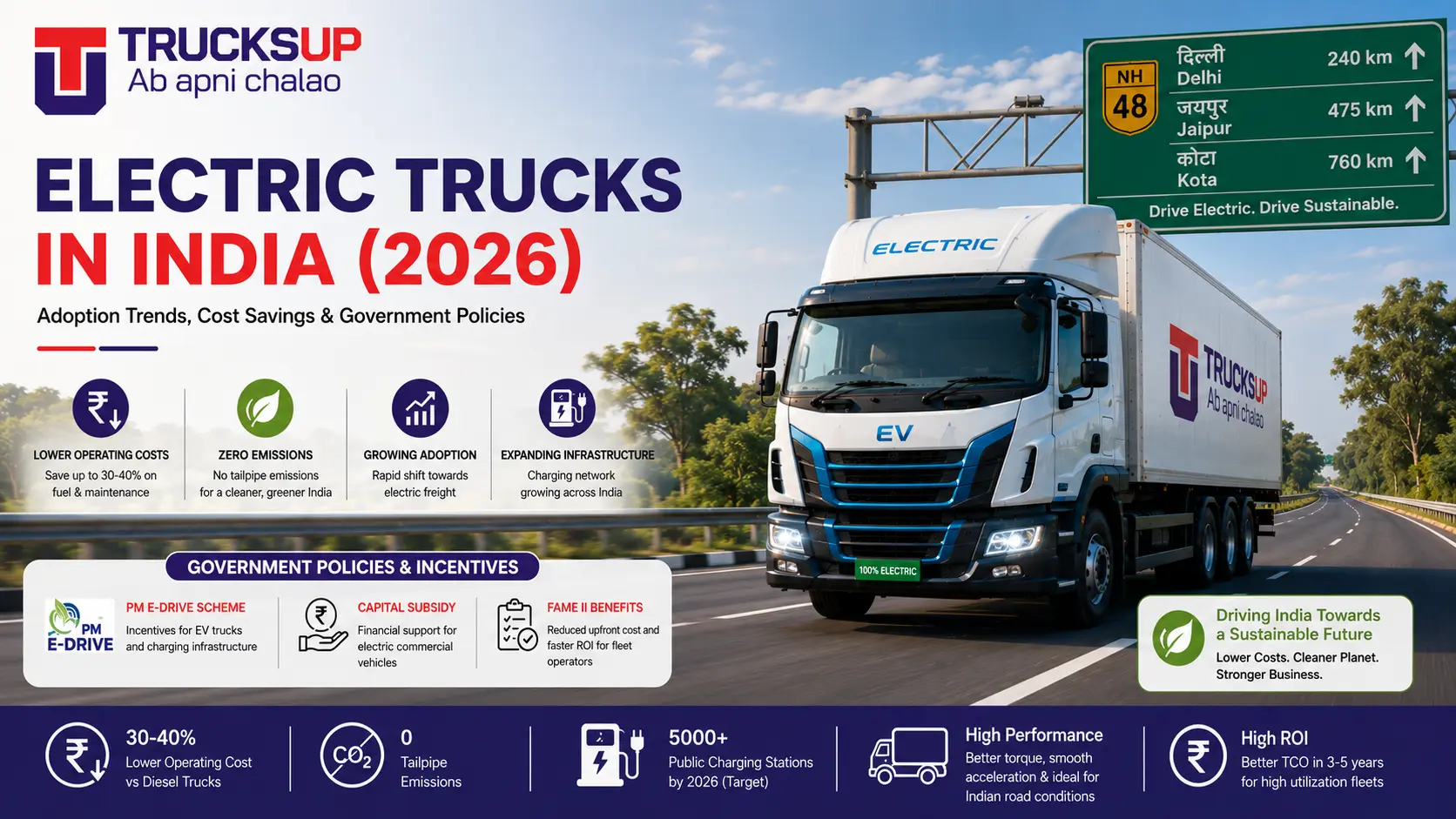
Introduction
India’s trucking industry is entering a major transformation phase. Rising diesel prices, stricter emission regulations, corporate sustainability commitments, and government incentives are encouraging fleet operators to explore electric trucks.
In 2026, electric trucks are no longer limited to pilot projects or experimental deployments. They are becoming commercially viable for urban logistics, port operations, warehouse distribution, last-mile delivery, and short-haul freight movement.
For transporters and fleet owners, the question is no longer whether electric trucks will become mainstream. The real question is whether early adoption can create a long-term competitive and cost advantage.
This guide explains electric truck adoption trends in India, cost-saving opportunities, government policies, charging infrastructure developments, and practical considerations for transport businesses.
Key Takeaways
- Electric trucks can significantly reduce fuel costs.
- Urban freight operations offer the fastest return on investment.
- Government incentives are improving fleet economics.
- Charging infrastructure is expanding rapidly.
- Early adopters may gain access to premium logistics contracts.
- Short-haul freight operations will lead India's commercial vehicle electrification journey.
Why Electric Trucks Are Becoming Important in India in 2026
The Indian logistics industry spends nearly 40-45% of operating expenses on fuel alone, making diesel price fluctuations a major risk for transporter profitability. Electric trucks are gaining momentum due to several market, policy, and customer-driven factors.
Market Driver | Impact on Transporters |
Rising diesel prices | Reduces profitability and increases freight costs |
Corporate ESG commitments | Creates demand for greener transportation partners |
Government EV incentives | Improves affordability of electric fleet acquisition |
Urban emission regulations | Provides easier access to restricted city zones |
Lower maintenance requirements | Reduces downtime and repair expenses |
Expansion of charging infrastructure | Improves route feasibility and operational flexibility |
Sustainability-focused contracts | Creates opportunities with premium enterprise clients |
Large shippers in FMCG, ecommerce, pharmaceuticals, manufacturing, and retail sectors are increasingly prioritizing transport partners with low-emission fleets. Several manufacturers and logistics operators are already testing electric fleets on fixed and predictable routes. Pilot programs are being conducted by companies such as Tata Motors, Ashok Leyland and Mahindra Last Mile Mobility.
Current State of Electric Truck Adoption in India
Although electric truck penetration remains relatively small compared to diesel commercial vehicles, adoption is accelerating rapidly across multiple freight segments. The Government of India has included N2 and N3 category electric trucks under national EV incentive programs to encourage fleet electrification. The support provided through the PM E-DRIVE Scheme aims to accelerate electric commercial vehicle adoption and charging infrastructure development.
The current adoption landscape can be summarized as follows:
Eligible Vehicle Categories | High-Adoption Segments | Major Deployment Corridors |
N2 Trucks: 3.5–12 tonnes | Port logistics | Delhi NCR |
N3 Trucks: 12–55 tonnes | Urban freight distribution | Mumbai Metropolitan Region |
Covers medium and heavy commercial vehicles | Intra-city transportation | Bengaluru |
Industrial corridors | Chennai | |
Warehouse distribution networks | Ahmedabad |
Where Electric Trucks Make Commercial Sense
Electric trucks currently perform best in operations involving fixed routes, predictable schedules, and daily return-to-base movement patterns.
Urban Distribution: Electric trucks are ideal for daily movement between warehouses, retail stores, supermarkets, and urban distribution centers with predictable mileage.
Port Operations: Ports and logistics parks benefit from electric trucks because routes remain repetitive, short-distance, and operationally predictable every day.
FMCG Deliveries: FMCG companies operate frequent delivery cycles on fixed routes, making charging schedules easier and utilization rates higher.
Ecommerce Logistics: Hub-to-hub ecommerce transportation allows operators to integrate charging windows into existing loading and unloading schedules efficiently.
Industrial Cluster Transportation: Manufacturing hubs often require repetitive freight movement between factories and warehouses located within short operating distances.
Biggest Advantages of Electric Trucks vs Diesel Trucks Comparison
Parameter | Electric Trucks | Diesel Trucks |
Fuel Cost | Significantly lower operating cost | Highly dependent on diesel prices |
Maintenance Cost | Fewer moving parts and lower servicing costs | Higher maintenance and engine servicing expenses |
Energy Price Stability | Electricity prices remain relatively stable | Diesel prices fluctuate frequently |
Emissions | Zero tailpipe emissions | High carbon emissions |
Noise Levels | Quiet operation suitable for urban areas | Higher engine noise |
Government Incentives | Eligible for subsidies and incentives | Limited support available |
Urban Access | Better compliance with future city regulations | May face future restrictions |
Total Cost of Ownership | Lower over long operating periods | Lower upfront cost but higher operating expenses |
Sustainability Compliance | Supports ESG and green logistics goals | Difficult to align with sustainability mandates |
Government Policies Supporting Electric Trucks
The biggest policy support currently comes from the Government of India’s PM E-DRIVE Scheme and The program has a total allocation of ₹10,900 crore to accelerate EV adoption across the country.
Out of this, ₹500 crore has been earmarked specifically for electric truck incentives. Additional support is also available for fleet owners replacing older diesel vehicles with eligible electric alternatives. These initiatives aim to reduce the financial burden associated with fleet electrification and encourage early adoption.
Charging Infrastructure Expansion
Charging availability remains one of the largest concerns for fleet operators considering electric trucks.
The PM E-DRIVE initiative includes:
- 22,100 fast chargers for electric four-wheelers
- 1,800 fast chargers for electric buses
- 48,400 chargers for smaller EV categories
Additionally, ₹2,000 crore has been allocated for charging infrastructure deployment across highways, logistics hubs, industrial corridors, and high-demand urban locations. Improved charging infrastructure will be a major catalyst for electric truck adoption over the next decade.
Impact of Fuel Prices on EV Adoption
Diesel price volatility continues to create uncertainty for transporters operating under fixed-rate freight contracts. Even a ₹5 per litre increase in diesel prices can significantly affect fleet profitability and operating margins. In contrast, electric trucks provide greater cost predictability because electricity prices are generally more stable than diesel prices. This stability enables transporters to negotiate long-term contracts with greater confidence while reducing exposure to fuel price fluctuations.
Major Challenges Slowing Electric Truck Adoption
Despite strong growth potential, several challenges continue to slow large-scale adoption of electric trucks in India:
High Initial Purchase Cost: Battery technology remains the largest cost component, making electric trucks more expensive than comparable diesel vehicles.
Limited Charging Infrastructure: India’s long-haul freight network still requires substantial expansion of fast-charging facilities.
Range Limitations: Most currently available electric truck models are better suited for urban deliveries and regional freight operations.
Payload Constraints: Battery systems can reduce payload capacity in certain commercial vehicle categories, impacting revenue potential per trip.
Future Outlook: What Will Change by 2030?
Several developments are expected to accelerate electric truck adoption across India over the next decade:
- Declining battery prices
- Expansion of charging infrastructure
- Availability of faster charging technology
- Growing corporate sustainability commitments
- Stricter emission regulations
- Development of dedicated green freight corridors
As these factors converge, India’s logistics industry is expected to witness rapid electrification in urban freight and regional distribution networks before large-scale adoption expands into long-haul trucking operations.
What Transporters Should Do Today
Transporters should avoid an all-or-nothing approach to fleet electrification. A phased adoption strategy typically delivers better results and lower operational risk.
Fleet owners should:
- Identify routes operating below 250 km per day.
- Start with pilot deployments on suitable routes.
- Measure real-world operating performance and costs.
- Compare total cost of ownership against diesel alternatives.
- Scale deployment only after validating operational efficiency.
Early adopters are likely to gain a competitive advantage by securing contracts from large enterprises and sustainability-focused shippers seeking lower-emission logistics partners.
Frequently Asked Questions
1. Are Electric Trucks Cheaper To Operate Than Diesel Trucks?
Ans: Yes. Electric trucks can reduce running costs by up to 60%, depending on electricity prices and route utilization.
2. How Much Can Transporters Save Using Electric Trucks?
Ans: Many fleet operators can save approximately ₹15-17 per kilometre in energy costs alone.
3. Does The Government Provide Subsidies For Electric Trucks?
Ans: Yes. India’s PM E-DRIVE Scheme includes incentives specifically designed for electric trucks.
4. Are Electric Trucks Suitable For Long-Distance Transport?
Ans: Currently, electric trucks are better suited for urban and regional freight operations than long-haul routes.
Which Industries Are Adopting Electric Trucks The Fastest?
Ans: Ecommerce, FMCG, retail distribution, ports, and industrial logistics are leading adoption.
6. What Are The Benefits Of Electric Trucks In India?
Ans: Electric trucks reduce fuel costs, lower maintenance expenses, improve sustainability compliance, and reduce operating costs.
7. How much can electric trucks save per kilometre?
Ans: Electric trucks can save approximately ₹15-17 per kilometre compared to diesel trucks, depending on electricity prices and route utilization.